

Ultrasound guided Corticosteroid Injections - Macedon Ranges Podiatry
Our Podiatrist provides dry needling & prolotherapy to help relax and relieve muscle pain in order to prevent future complications.
17264
portfolio_page-template-default,single,single-portfolio_page,postid-17264,ajax_fade,page_not_loaded,,qode-theme-ver-10.1.2,wpb-js-composer js-comp-ver-5.1,vc_responsive
 

Ultrasound guided Corticosteroid Injections

Category
services

Ultrasound guided Corticosteroid Injections

Our podiatrist, Andrew Baddeley, has completed further training to become endorsed
to prescribe scheduled medicines. This means we can provide a range of additional
treatments for his patients, including various injections to manage pain such as
corticosteroid injection and long-acting anaesthetics. Andrew also uses an
ultrasound-guided technique which ensures that needle placement is more precise,
meaning less medicine is required to achieve the required outcome.
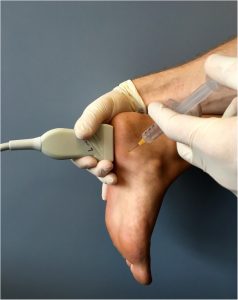
A steroid injections (also called cortisone or corticosteroid injections) can reduce pain and inflammation associated with certain musculoskeletal and sporting conditions. These injections are often not a first-line treatment, but can be an important part of a comprehensive treatment plan. When used appropriately, steroids are safe and can be very effective.

Conditions that may respond to steroid injection include:

  • intermetatarsal neuroma (also known as Morton’s neuroma)
  • arthritis
  • plantar fasciitis
  • plantar fibroma
  • ganglionic cysts
  • bursitis

A steroid injection can be administered in different ways depending on the location of
the complaint. For some complaints, the steroid can be injected directly into the area
(such as bursitis or a ganglion). However, for some regions of the foot an injection can be uncomfortable, so a local anaesthetic injection is administered behind the ankle. This numbs the foot and makes the steroid injection more comfortable. This approach can be used for plantar fasciitis injections.

Benefits of Cortisone Injections

  • Targeted treatment: The injections are administered directly into the affected
    joint or tissue
  • Non-surgical: They can help avoid the need for more invasive treatments like
    surgery
  • Convenience: The procedure is simple and can be done in the podiatrists
    rooms.
  • Rapid pain relief: Cortisone injections can quickly reduce inflammation and
    swelling

What to expect

The injection site will be cleaned with an anti-septic. A small needle will be used to
direct the steroid into the tissue. Some discomfort may be experienced, however it
will be brief. You may have numbness in the region of the injection for several hours,
so it is important that you can rest for at least 24 hours afterward.

What to know more?

If you would like to know more about ultrasound guided corticosteroid injections, please contact our Podiatrist via our website www.rangespodiatry.com.au

Safety considerations

Although this is a very common treatment, occasionally people can experience
adverse effects. The most common adverse effects are outlined below:

Pain and discomfort

  • as with any injection, you may experience some pain and discomfort
    during the actual injection. In addition, two to three days following the
    procedure you may experience some localised swelling, and pain at
    the injection site.

Infection

  • as with any injection, there is a very low risk of an infection at the injection site, although rare. This risk will be minimised by ensuring all equipment is sterile and your foot and ankle are disinfected prior to the injection.

Nerve injury

  • ​when administering the injection to your foot, the needle may be placed
    close to a nerve. Occasionally, you may experience some nerve sensations if the needle touches the nerve. This may feel like ‘pins and needles’ or a localised ‘electric shock’. Sometimes people will experience these symptoms for a few days following the injection.

Local anaesthetic allergy

  • ​there is a risk of allergy to the local anaesthetic mixed with the steroid.
    This risk is very small and you will be questioned prior to the injection
    of any known allergies to local anaesthetics.

Thinning of fat

  • in less than 1% of corticosteroid injections the fat where the steroid is administered may reduce in thickness. This fat usually returns between 6 and 30 months after the injection.

Local skin discolouration

  • very rarely people will experience a loss of pigmentation at the area near a steroid injection. These changes have been reported to last between two to eleven months.

Long-acting anaesthetic

Long acting local-anaesthetics can reduce pain associated with some conditions or
procedures, and can be used to help diagnose certain conditions. Some conditions
such as sinus tarsi syndrome can be quite painful, but are difficult to diagnose
clinically and with imaging. An anaesthetic injection in the painful location can
confirm a diagnosis.

In addition, the injection of fluid within the tissue can be beneficial for some
conditions where there may be fibrosis or scarring that has developed.